

MINDFUL ROUTINES · AROMATHERAPY & HOME FRAGRANCE
Home Fragrance Guide: Diffusers, Candles and Mists by Room
How to choose and combine diffusers, candles, reed diffusers and room mists for each room—with a simple approach to scent families, strength, layering and safety.

Home fragrance is one of the quickest ways to change how a room feels, and one of the easiest to overdo. A single candle at dusk, a light mist in the hallway or a diffuser running quietly in the living room can make a home feel cared for. Several strong scents competing at once tend to do the opposite.
The difficulty is that most advice treats each product on its own. Diffuser guides discuss diffusers, candle guides discuss candles, and very little helps you decide which method suits which room, or how the different scents in a home should relate to one another.
This guide takes the wider view. It compares the main ways to scent a home, explains how to choose by room, routine and household, and shows how to build a restrained, connected scent routine rather than a collection of competing products. Where a topic deserves more detail, it links to our dedicated guides.
As with the rest of our journal, this guide is about fragrance, ambience and practical use. It does not treat essential oils or scented products as treatments, and it does not make health claims.
What Home Fragrance Does, and What It Does Not
Scent works as a background layer of a room, much like lighting or texture. When it is well judged, people notice that a space feels welcoming without being able to point to why. When it is too strong, it becomes the first thing anyone notices, and often the reason they want to open a window.
It helps to be clear about the limits. Fragrance can mark a routine, such as the end of the working day, and it can make a room feel finished. It cannot fix a stale room. Good ventilation, clean textiles and regular emptying of bins do more for how a home smells than any product, and fragrance layered on top of those basics simply works better.
A useful principle for the rest of this guide is less, but deliberately: fewer sources, lighter output and scents chosen for a specific room and time of day.
The Main Ways to Scent a Home
Each method releases fragrance differently. The differences affect how far the scent travels, how long it lasts, how much attention it needs and whether it is suitable for a particular room.
AT A GLANCE
Five ways to scent a home
Waterless diffuser
Ultrasonic diffuser
Reed diffuser
Candle
Room mist
Waterless and nebulising diffusers
Waterless diffusers break fragrance oil into a very fine mist without water. Because nothing dilutes the oil, they can scent a larger room from a small device, which also means output needs careful control. Most have timers or intermittent settings, and these are worth using from the start.
They suit living rooms, open-plan spaces and hallways where you want an even, background scent. Use oils the manufacturer specifies for the device, and see our diffusers and diffuser oils for compatible options. For a deeper comparison of diffuser types, read our oil diffuser guide.
Ultrasonic diffusers
Ultrasonic diffusers vibrate water and a few drops of oil into a cool mist. They are gentler than waterless models and easy to adjust by adding fewer drops, though they need regular emptying and cleaning, and the water reservoir limits how long they run.
They work well in bedrooms, studies and smaller rooms where a softer scent is enough. Our ultrasonic diffuser guide covers reservoir size, noise, timers and cleaning in detail.
Reed and passive diffusers
Passive methods, such as reeds in a scented liquid, release fragrance through slow evaporation. There is no power, flame or timer, so the scent is constant but quieter, and it is strongest close to the source.
They are useful in hallways, bathrooms and cloakrooms, where a steady low level of scent is welcome and you do not want to switch anything on. Turning the reeds refreshes the scent; turning them too often uses the liquid faster.
Candles
Candles combine scent with flame and light, which is why they feel so connected to evening routines. A scented candle releases fragrance mainly once a melt pool forms; an unscented candle, such as natural beeswax, adds warmth and light without competing with other scents in the room.
Because they involve an open flame, candles need attention every time they are lit. They suit living and dining rooms in the evening, and they are a poor choice for rooms you will leave, or rooms where children or pets could reach them. Browse our natural candles for beeswax and scented options.
Room mists and sprays
A room mist or room spray gives an immediate, short-lived burst of fragrance. That makes it the most flexible method: a light spray in the hallway before guests arrive, or on the landing in the morning, without committing a room to scent all day.
Spray into the air rather than directly onto fabrics or furniture unless the product says it is suitable for textiles, and test on an inconspicuous area first. Our aromatherapy collection includes room mists alongside oils.
Oils and blends
Oils are the raw material for diffusers rather than a method in themselves. The choice between single oils and ready-made blends, and between essential oils and fragrance oils, shapes the character of every diffuser in the home. Our beginner’s guide to aromatherapy oils explains the labels, and our essential oil blends guide shows how to build balanced combinations.
A quick comparison
| Method | Reach | How long it lasts | Upkeep | Best for |
|---|---|---|---|---|
| Waterless diffuser | Large rooms and open-plan spaces | As long as it runs; use timers | Clean nozzle; refill oil | Even background scent in living spaces |
| Ultrasonic diffuser | Small to medium rooms | One reservoir at a time | Empty and clean regularly | Bedrooms, studies, softer scent |
| Reed or passive diffuser | Close to the source | Continuous, gradually fading | Turn reeds occasionally | Hallways, bathrooms, cloakrooms |
| Scented candle | Medium rooms, once a melt pool forms | While lit, plus a short afterglow | Trim wick; never leave unattended | Evenings in living and dining rooms |
| Room mist | The immediate area | Minutes rather than hours | None | Quick refresh, entrances, before guests |
How to Choose the Right Method
Rather than starting with a scent you like, start with the room and how you use it. Five questions narrow the choice quickly.
- How large and open is the space? Open-plan rooms usually need an active diffuser; a small cloakroom may only need a passive one.
- How long do you want scent present? All evening suggests a diffuser on a timer or a candle; a moment of freshness suggests a mist.
- Will someone be in the room? Candles need someone present the whole time they burn. Diffusers with automatic shut-off are better for rooms you move in and out of.
- Who shares the space? Children, pets and anyone sensitive to fragrance change both the method and the strength. See the section on shared spaces below.
- How much upkeep will you realistically do? An ultrasonic diffuser that is not cleaned soon smells stale. A passive method may suit a busy household better.
Most homes end up with two or three methods: perhaps a diffuser in the main living space, a passive diffuser in the hallway and candles reserved for the evening.
Choosing a Scent: Fragrance Families
Thinking in families rather than individual scents makes it easier to choose fragrances that sit well together across the home. Most home fragrances fall broadly into five groups.
| Family | Typical notes | Character | Often used in |
|---|---|---|---|
| Fresh and citrus | Lemon, lime, bergamot, grapefruit | Bright, clean, lively | Kitchens, hallways, mornings |
| Green and herbal | Lemongrass, rosemary, eucalyptus, fig leaf | Crisp, natural, open | Studies, bathrooms, spring and summer |
| Floral | Rose, jasmine, ylang ylang, lavender | Soft, rounded, gentle | Bedrooms, living rooms |
| Woody | Sandalwood, cedar, pine, vetiver | Grounded, calm, warm | Living rooms, reading corners, autumn |
| Warm and resinous | Amber, oud, vanilla, frankincense | Rich, enveloping, intense | Evenings, winter, used sparingly |
These are general descriptions rather than rules. A light floral can feel fresh, and a dry woody scent can be very restrained. Test a scent in the room itself, at the strength you would actually use, before deciding.
Warm and resinous scents are usually the strongest, so they need the lightest touch. If you are new to home fragrance, fresh, green and woody scents are generally easier to live with every day.
Planning Fragrance Room by Room
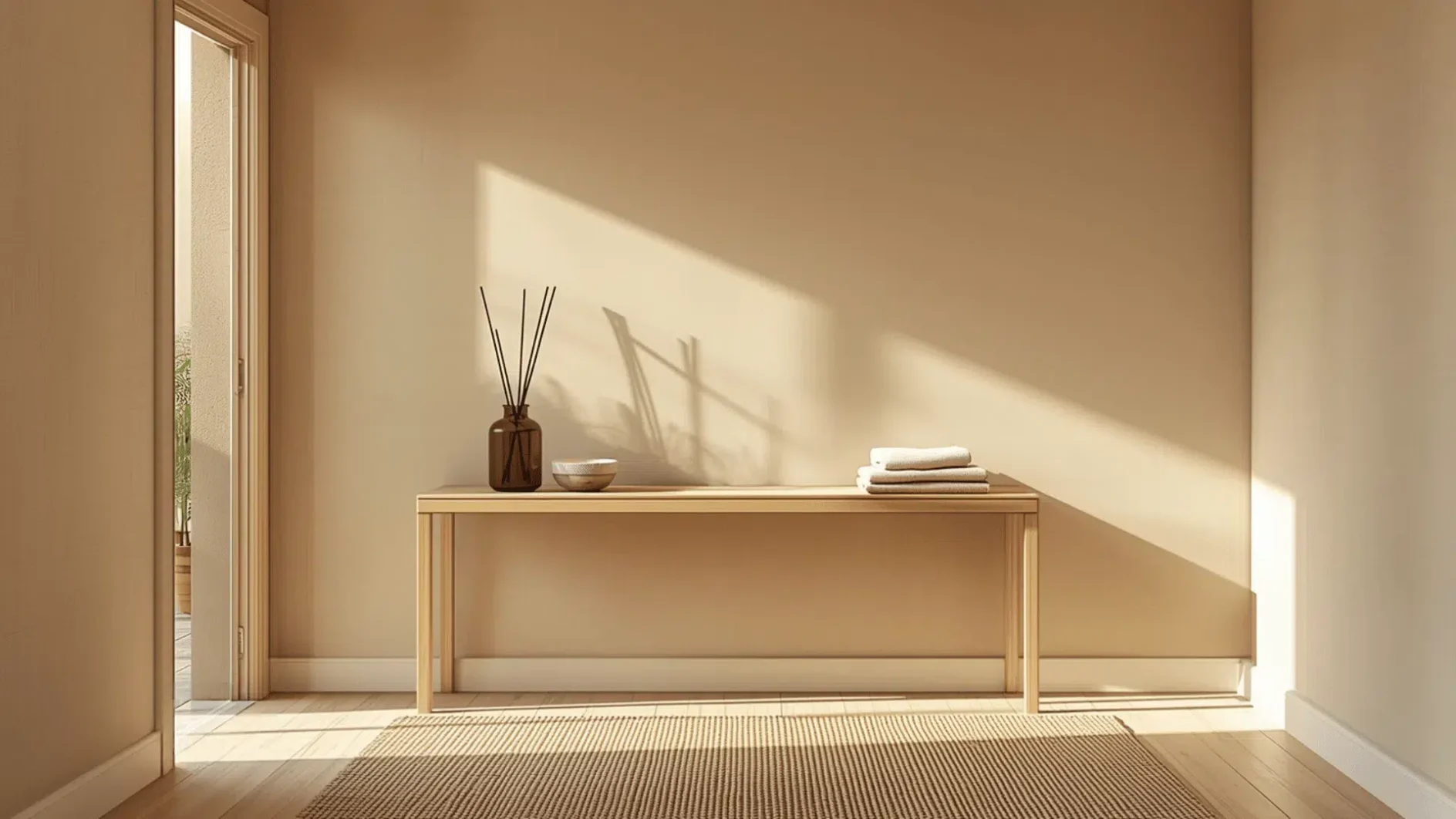
Different rooms ask for different strengths and methods. The table below is a starting point; our room diffuser guide goes into each room in more detail.
| Room | Suggested method | Strength | Notes |
|---|---|---|---|
| Hallway and entrance | Reed diffuser or a room mist | Light | First impression of the home; keep it fresh rather than heavy |
| Living room | Waterless diffuser on a timer; candles in the evening | Light to moderate | The room where scent and light work together most |
| Kitchen and dining | Mist after cooking; unscented candles at the table | Very light | Avoid competing with food; ventilation matters most |
| Bedroom | Ultrasonic diffuser before bed, switched off for sleep | Very light | Choose quieter devices; never sleep with a candle lit |
| Bathroom | Reed diffuser | Light | Humidity can shorten the life of reeds and labels |
| Home office | Ultrasonic diffuser in short sessions | Very light | Fresh or green scents are least distracting |
Layering Scent Across the Home
The most common reason a home feels over-scented is not one strong product but several unrelated ones. A vanilla candle in the living room, a citrus diffuser in the kitchen and a floral mist in the hallway can collide wherever the spaces meet.
Three habits keep scent connected:
- Choose a family for the house. Pick one or two families that suit you and use them in most rooms. Variation within a family feels deliberate; jumping between families feels busy.
- Give each zone one active source. One diffuser, candle or reed set per room or open-plan zone is usually enough.
- Use the strongest scents in the most closed rooms. Doors contain fragrance; open-plan spaces spread it.
Unscented candles are useful here. They bring flame and warmth to a room that already has a diffuser running, without adding a second scent. Our blending guide also explains how to create continuity between adjacent spaces.
Strength, Timing and Placement
Most fragrance problems are problems of quantity. Start with less than you think you need and increase slowly, because the nose adapts quickly. After twenty minutes in a scented room you notice it far less than someone walking in.
Start low and test from the doorway
Set a diffuser to its lowest or intermittent setting, leave the room for a few minutes and judge the scent when you come back in. If you can only notice it close to the source, increase it a little; if it greets you at the door, reduce it.
Use timers and short sessions
An hour before guests arrive, or the first part of the evening, is often enough. Timers prevent the gradual build-up that happens when a diffuser runs all day.
Place sources where air moves gently
A diffuser or reed set near a doorway or in the path of gentle airflow spreads scent more evenly than one tucked in a corner. Keep devices away from direct heat, electronics and delicate finishes, and keep candles well away from curtains, shelves above them and anything that could be knocked.
Fragrance in Daily Routines and Seasons
Scent is closely tied to habit, which is why it works well as a cue. A bright mist in the morning, a woody diffuser while you read or a candle lit at the same time each evening can help mark the shape of the day. Our evening routine ideas and morning routine ideas explore this further.
You do not need a new collection each season. A small shift is usually enough: fresher citrus and green scents in spring and summer, when windows are open; woodier, warmer scents in autumn and winter, when rooms are closed and evenings are longer. Because closed rooms hold scent more strongly, winter is also the time to reduce output rather than increase it.
Shared Spaces, Air Quality and Safety
Fragrance is shared by everyone in the room, so it is worth considering who else lives with it.
Ventilation comes first
Scented products add to what is already in the air indoors. The UK Health Security Agency notes that opening windows and doors is the simplest way to improve ventilation at home, and that even brief or partial opening helps in colder weather (UKHSA ventilation guidance). A short airing before and after using fragrance keeps a room fresher and lets a lighter scent go further.
Candles and open flame
Fire and rescue services advise never leaving candles unattended, putting them out before leaving a room or going to sleep, using a heat-resistant holder and keeping them away from curtains and soft furnishings (North Yorkshire Fire and Rescue Service). Their advice also warns against placing tealights directly on baths or televisions, and against positions where candles could be knocked over or reached by children and pets.
Children, pets and sensitive households
Keep oils, devices and candles out of reach, and follow the product label and manufacturer’s guidance. Animals can be more sensitive to some fragrance materials than people, so if you have pets, ask your vet before using diffusers, and always leave them a way to move to an unscented room. If anyone in the household has asthma, allergies or is sensitive to fragrance, use scent sparingly, choose methods that are easy to switch off and take their lead.
Care, Storage and Making Fragrance Last
Looking after fragrance products keeps scents true and stops devices smelling stale.
- Clean diffusers regularly, following the manufacturer’s instructions, so old oil does not mix with new blends.
- Store oils upright, sealed and away from light and heat, which helps preserve their character.
- Trim candle wicks before relighting and let the first burn form an even melt pool, which helps the candle burn evenly.
- Keep reed diffusers out of direct sun and draughts, which shorten their life.
- Rest your nose. If a scent seems to have faded, step outside the room before adding more.
Common Home Fragrance Mistakes
- Using several unrelated scents in connected rooms.
- Running diffusers all day instead of in short sessions.
- Judging strength after sitting in the room for an hour.
- Using fragrance to cover a ventilation or cleaning problem.
- Choosing intense warm scents for small, closed rooms.
- Leaving a candle burning in an empty room.
- Using oils a device was not designed for.
- Forgetting that pets and guests share the air too.
A Simple Home Fragrance Checklist
- Air the room first.
- Choose one or two fragrance families for the home.
- Give each room or zone one active source.
- Match the method to the room and how long you are in it.
- Start on the lowest setting and test from the doorway.
- Use timers or short sessions.
- Never leave a candle unattended.
- Clean devices and store oils carefully.
Frequently Asked Questions About Home Fragrance
How do I make my home smell nice?
Start with ventilation and clean textiles, then add one light source of fragrance per room. A diffuser on a timer suits living spaces, a reed diffuser suits hallways and bathrooms, and a room mist gives a quick refresh.
Is a diffuser or a candle better for home fragrance?
They do different jobs. A diffuser gives steadier, adjustable scent and can run on a timer; a candle adds light and warmth but needs someone present the whole time. Many homes use a diffuser for background scent and candles for evenings.
How many scents should I use in one home?
Fewer than you might expect. One or two fragrance families used across the home usually feel more considered than a different scent in every room.
How long should I run a diffuser?
Follow the manufacturer’s guidance for your device. For fragrance quality, short or intermittent sessions are often enough, and they make it easier to judge the scent level.
Can I use home fragrance if I have pets?
Ask your vet before using diffusers or oils around pets, keep products out of reach, and make sure animals can move to an unscented room.
Why can I no longer smell my diffuser or candle?
Your nose adapts to a constant scent quite quickly. Leave the room for a few minutes and come back before deciding to add more.
Which essential oil is best for home fragrance?
There is no single best oil; it depends on the room and the effect you want. Fresh citrus oils such as lemon or lime suit kitchens and mornings, lavender and other soft florals suit bedrooms, and woody oils such as sandalwood or cedar suit living rooms in the evening. Check that any oil is compatible with your diffuser, and see our aromatherapy oils guide for how to read labels.
Are home fragrances bad for you?
Scented products add to what is already in the air indoors, so use them in moderation, follow the product label and keep rooms well ventilated. If anyone in the household has asthma, allergies or is sensitive to fragrance, use scent sparingly or not at all, and ask a GP or pharmacist if you have concerns.
Let Scent Support the Room
Good home fragrance rarely announces itself. It comes from choosing the right method for each space, keeping scents within a family, using less than you first think and giving the air in the room as much attention as the fragrance itself.
Start with one room and one source, live with it for a week, and build from there. Explore our home fragrance and rituals collection when you are ready, or continue with the guides below.
AROMATHERAPY & HOME FRAGRANCE
Explore Home Fragrance
Diffuser types
Oil Diffuser Guide: Types, Placement and Everyday Use
Ultrasonic diffuser
Ultrasonic Diffuser Guide: How It Works and What to Look For
Room by room
Room Diffuser Guide: Choosing Fragrance for Different Spaces
Aromatherapy oils
Aromatherapy Oils: A Beginner’s Guide to Choosing and Using Them at Home
Oil blends
Essential Oil Blends: How to Build Balanced Home-Fragrance Combinations
Candle fragrance
Aromatherapy Oils for Candle Making: What to Know Before You Blend
Reed diffusers
Reed Diffusers: How to Use, Place and Refresh Them
Waterless diffusers
Waterless Diffusers: How They Work and How to Use Them

Leave a Reply